.png)
How Murphy Became Pet Lore’s Mascot
Updated: Jun 6
A childhood llama, a decade of animal doodles, and the long process of finding the right guide for Pet Lore.

Why Pet Lore Needed a Mascot
When I first started building Pet Lore, I knew the platform needed to feel warm, personal, and welcoming — but not childish.
Pet Lore is a story-centered space for the lives we share with animals. It includes joyful memories, funny routines, family lore, service animal stories, grief, aging, milestones, and the everyday details that make an animal feel woven into a person’s life.
Because of that, the experience needed more than a logo.
After looking at how mascots and guide characters can help make digital products feel more approachable, I started thinking seriously about whether Pet Lore needed one too. Not a cartoon character for decoration, but a gentle presence that could help guide people through memory-keeping, prompts, journal features, and moments that may sometimes be emotional.
The right mascot could make Pet Lore feel less like software and more like a companion.
That became the goal.
Long before Pet Lore existed, animals were already appearing in the margins of my notebooks.
The Character Was Already There
What surprised me most was that Murphy did not feel like something I invented from scratch.
When I looked back through old photos of my notebooks and work journals, I found animal doodles from around 2016 — years before Pet Lore existed. There were cats, llamas, hearts, dotted trails, fluffy silhouettes, oversized eyes, and little characters that looked like they belonged in the same emotional world I was now trying to build.
At the time, they were just doodles. I was not designing a mascot. I was probably sitting in a meeting, thinking through work, or letting my hand wander across the page.
But looking back, the pattern was obvious: animals had been showing up in my creative margins for years.
That made the mascot feel less like a branding exercise and more like a character who had been waiting for the right home.
Why "Murphy"
The name Murphy comes from one of my own pets.
That mattered to me. Pet Lore is not an abstract brand about “pet content.” It is rooted in real animals, real memories, and the emotional meaning they carry. Naming the mascot after one of my pets helped keep the character connected to the lived experience behind the project.
Murphy is meant to feel like a guide, not a spokesperson. Curious, gentle, loyal, a little whimsical, and quietly supportive.
The kind of presence that can sit beside a funny pet memory, a service animal story, or a memorial tribute without feeling out of place.
Why a Llama
Choosing a llama was intentional.
I did not want the mascot to be a dog or cat because Pet Lore is for all species: dogs, cats, birds, rabbits, reptiles, livestock, farm animals, service animals, and the many companions that do not fit neatly into the usual “pet” categories.
I also did not want something so obscure that it felt like niche internet lore or an inside joke.
A llama felt unusual but still familiar. Warm but not overly sentimental. Distinctive but not too specific. It also had a personal connection: I grew up with a llama on my family farm.
That gave Murphy the right mix of personal history and species neutrality.
A llama could represent Pet Lore without implying that one kind of animal mattered more than another.
The first explorations leaned into sweetness, but they also revealed what needed to change.
The First Versions Were Too Cute
The earliest versions of Murphy were charming — maybe too charming.
They had big eyes, bows, hearts, blush, and a very soft storybook quality. They were sweet, but they leaned a little too juvenile and a little too feminine for what Pet Lore needed to become.
Pet Lore has to welcome a wide range of people: pet owners, artists, writers, service animal handlers, researchers, livestock owners, grieving families, older adults, and people who may not think of themselves as “creative” at all.
A mascot that felt too cute risked narrowing the audience.
So the design question became: how do we keep Murphy warm without making him childish? How do we make her friendly without making him overly precious?
That question guided the next round of revisions.
Moving Toward a Calmer Guide
The next stage was about restraint. I started adjusting Murphy’s expression, accessories, color palette, and overall visual tone. The goal was to make her feel:
Warm
Curious
Calm
Supportive
A little whimsical
Some details were removed. Some were softened. Some were simplified.
The bow became a scarf. The expression became more neutral. The overall palette moved toward earthy greens, creams, warm browns, and soft vintage tones. .
Murphy became less of a “cute mascot” and more of a gentle guide.
This stage helped define Murphy’s personality: gentle, curious, supportive, loyal, thoughtful, and playful.
The Cute-to-Realistic Balance
One of the hardest parts was finding the right level of realism. Too cartoonish, and Murphy felt like she belonged in a children’s app.
Too realistic, and she stopped feeling like a mascot. Some versions looked more like a farm illustration, a veterinary clinic logo, or a stock animal portrait.
The right version had to sit in the middle. Murphy needed to feel like an actual animal — not a plush toy — but still have enough character to guide users through the Pet Lore world.
Eventually, I began referencing some elements of my Latvian ethnicity, particularly some vintage folk art that my mom and I have always enjoyed together.
That helped. A Lot. Murphy became less generic and more specific. The design kept its softness, but gained a more grounded quality.
That was the turning point. Murphy was no longer just “a llama mascot.”
She was Murphy.
The goal was not maximum cuteness or maximum realism, but the right emotional balance.
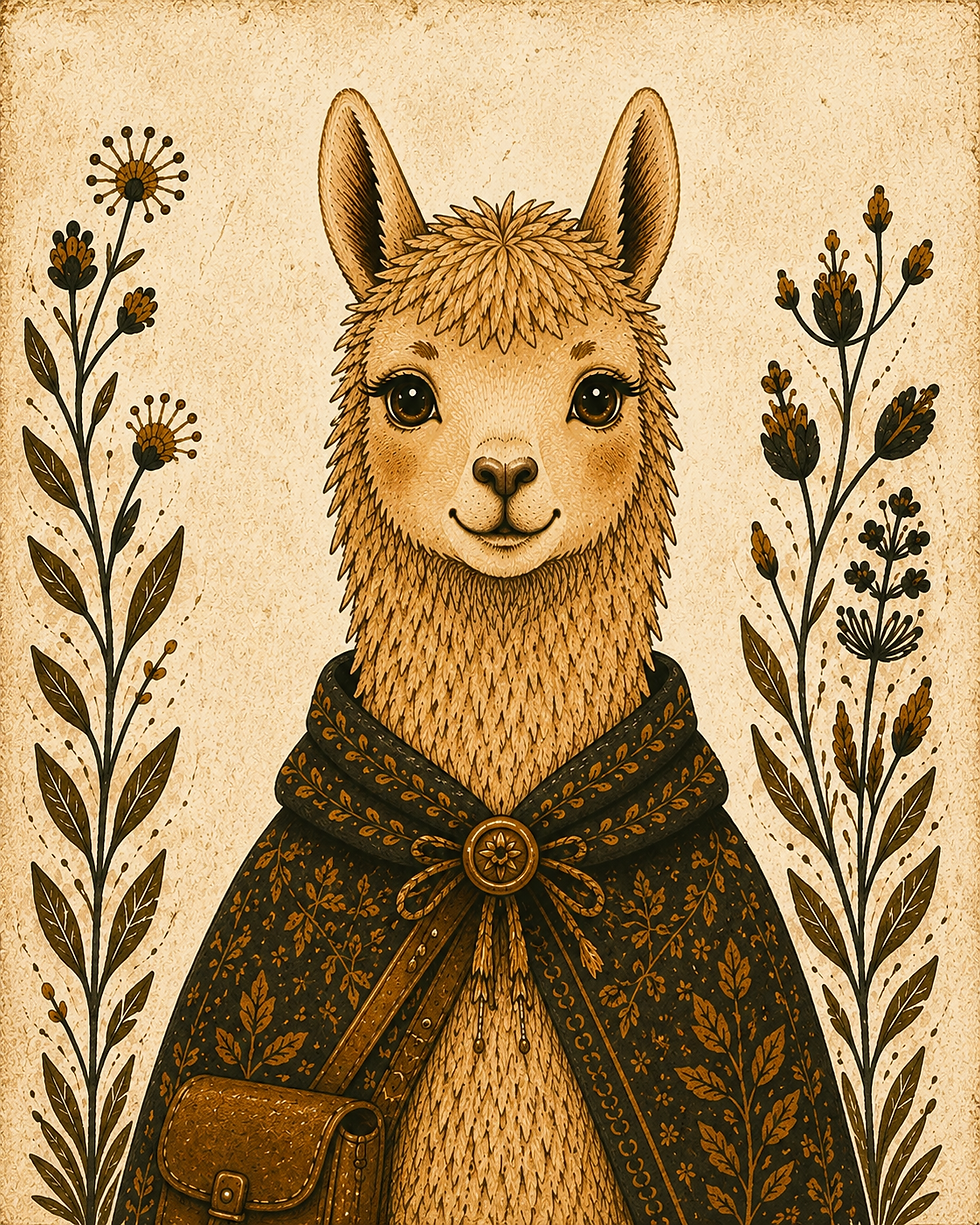
The final Murphy: warm, neutral, species-conscious, and designed to feel like a guide rather than a gimmick.
Why the Final Murphy Works
The final Murphy keeps the warmth of the early sketches, but with a calmer and more flexible design. Se is not the cutest possible version; nor is she is not the most realistic possible version. She is the version that can live across the whole Pet Lore ecosystem.
She can belong in the app, the website, beside journal content, and writing prompts.
She can accompany memory-keeping, grief, service animal stories, field notes, and everyday pet lore without feeling out of place.
The oval frame also became important. It gives Murphy the feeling of a portrait, a keepsake, or a character from an old family album.
That fits Pet Lore’s deeper purpose: preserving the emotional histories we build with animals.
AI as a Design Partner, Not a Replacement
Murphy’s development was AI-assisted, but not AI-led. The process began with my own drawings, memories, preferences, and design judgment. AI helped generate visual directions quickly, but each round required human decisions: what to keep, what to remove, what felt too cute, what felt too realistic, what aligned with the Pet Lore philosophy, and what did not.
That distinction matters to me. Pet Lore uses AI carefully and intentionally. The goal is not to replace human voice, memory, or creative judgment. The goal is to use tools where they can help surface possibilities, clarify direction, and support the work of shaping something meaningful.
Murphy is a good example of that process. AI helped me see options. But the character came from somewhere much older: childhood animals, old doodles, personal memory, and the emotional world Pet Lore is being built to protect.
What Murphy Represents
Murphy is not just a mascot. She is a visual reminder of what Pet Lore is trying to do.
She represents curiosity, care, memory, and gentle guidance. She also represents the idea that animal stories do not always arrive in polished form. Sometimes they begin as a photo, a half-remembered ritual, a funny habit, a family nickname, a loss, a sketch in the margins, or a detail you did not realize mattered until years later.
Murphy’s job is to help make those stories feel welcome.
Not every user will come to Pet Lore thinking of themselves as a writer. Not every story will begin as a finished essay. Some will begin with a prompt. Some with a memory. Some with grief. Some with a single image.
Murphy is there to say: start there.
Looking Back
Looking back, Murphy feels less like a mascot I invented and more like a character I eventually found. Long before Pet Lore existed, animals were already appearing in the margins of notebooks, work journals, and sketchbooks. A childhood llama lived somewhere in the background of my memory. A pet named Murphy gave the character her name. Dozens of design experiments helped refine her shape, color, expression, and role.
The final result is a llama with a green scarf, a calm expression, and a quiet job: to welcome people into a place built around preserving the stories we share with animals.
That feels right for Pet Lore. Because sometimes the story is already there.
You just need to notice it, shape it, and give it a name.
Comments